
ENRESFOOD
Ensure resilience of the food supply chain against safety and security shocks
Introduction
The main objectives of ENRESFOOD are to
increase the food system’s resilience by early identifying potential food safety threats
Choose resilience measures in a transparent manner
Improve the interaction between stakeholders to mitigate food safety threats
We consider two case-studies: the unintentional contamination of wheat with mycotoxins and the intentional contamination of infant formula.
The area researched is the European Union (EU) with partners from the Netherlands, Germany, Austria, and Italy.



Food Safety; Resilience; Drivers of change; Green AI; Multi-criteria; Economics; Stakeholders
2026-2029
TRL: 4-6
Background
The availability, access, and safety of foods in the EU is generally high. Yet, the food system is volatile and vulnerable to food safety threats. European food systems are increasingly exposed to both unintentional and intentional threats, including food contamination, fraud, cyber-attacks, geopolitical disruptions, and climate-related shocks. Such events can compromise food safety, disrupt supply chains, and undermine public trust, highlighting the need for more resilient and proactive food system governance. Current approaches often remain reactive and provide limited support for anticipating emerging risks or evaluating response strategies under uncertainty.
What we do
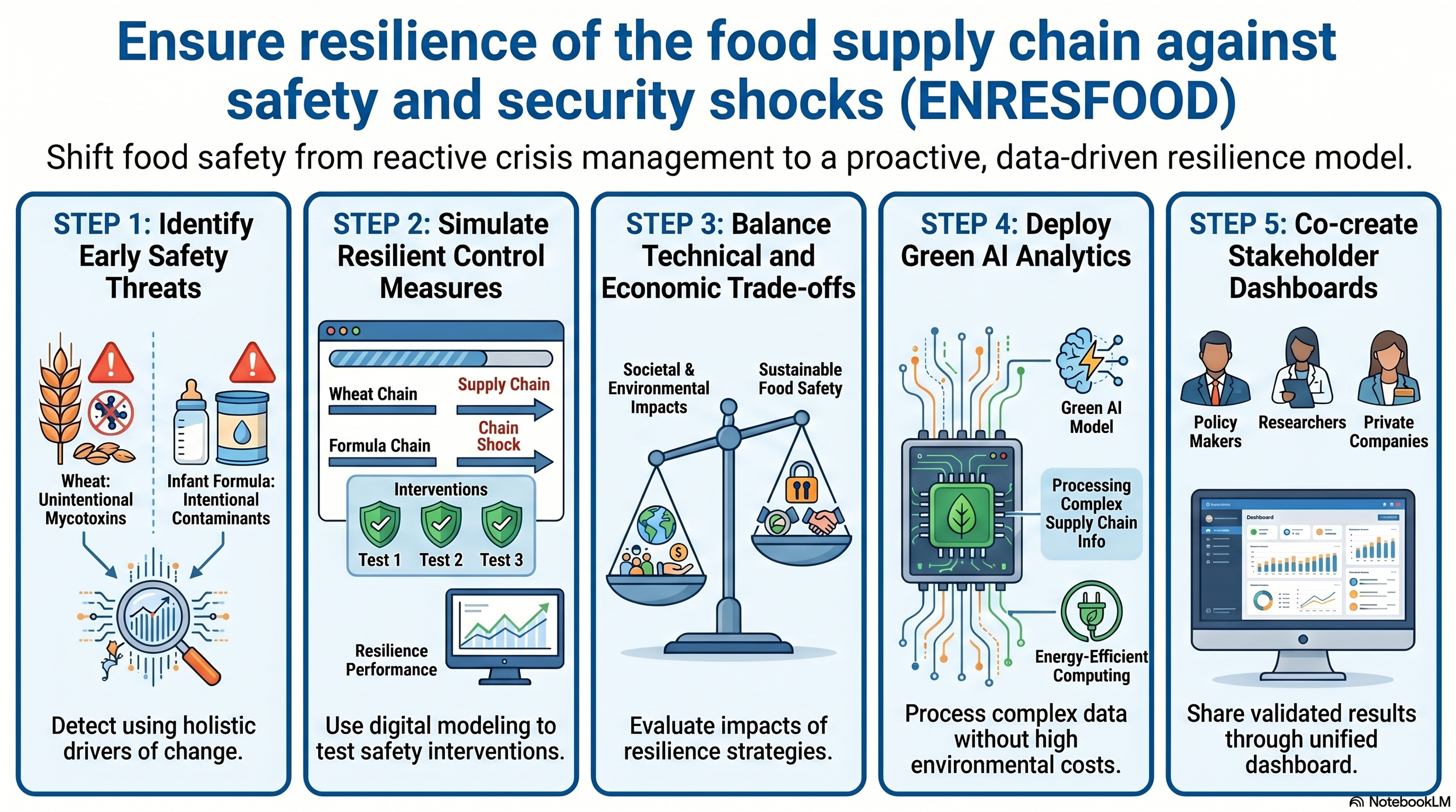
To increase the resilience of the food supply chain in practice, the project integrates five key activities:
Early identification of unintentional and intentional food safety threats via holistic drivers of change
Simulation modelling of control measures improving the resilience of the supply chain
The evaluation of societal, technical, and economic trade-offs of resilience strategies
Green AI, ensuring energy-efficient data analytics, and multi-model AI modelling approaches
The co-creation of a dashboard showing the results of the project together with stakeholders
Expected impact on food system transformation
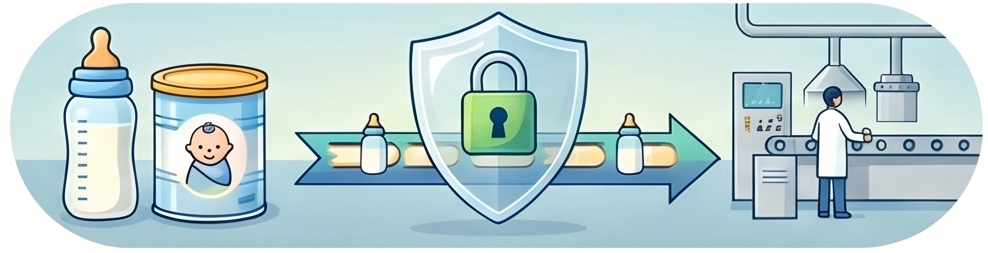
The project dives into two use-cases, namely the unintentional mycotoxin contamination of the wheat supply chain and the intentional contamination of the baby milk powder supply chain. The ENRESFOOD project aims at making both supply chains less vulnerable to food safety threats. By having stakeholders with different perspectives interact and discuss the choice of control measures, balanced measures are chosen and the public trust in food governance is improved. Furthermore, stakeholder interaction fosters learning and adaptation, also increasing the resilience of food supply chains.
.

Implementation and plans to reach target groups
The ENRESFOOD dashboard will be co-created with relevant stakeholders. A stakeholder board of 20 stakeholders from sector organisations, policy makers, private companies, and researchers will be assembled. Through surveys and workshops, the content of the dashboard will be tailored to the needs of the different stakeholders. The results of research in the project will be shared, discussed, and validated with the stakeholders.
Partners of the project
-
Marlous Focker & Bas van der Velden, Wageningen Food Safety Research, The Netherlands
Mail: marlous.focker@wur.nl
-
AIT Austrian Institute of Technology GmbH, Austria
University of the Bundeswehr Munich (Unibw M), Department of Social Sciences and Public Affairs, Germany
National Research Council of Italy (CNR), Italy
-
NL: Ministry of Agriculture, Fisheries, Food Security and Nature (LVVN)
DE: Federal Ministry of Research, Technology and Space (BMFTR)
AT: Austrian Science Fund (FWF)
o IT: Ministry of University and Research (MUR)