
Food-Frames
Scientific understanding of food information environments
Introduction
FOOD-FRAMES aims to advance scientific understanding of food information environments and their influence on dietary behaviours, in order to inform strategies that promote healthier and more sustainable diets across Europe. The project addresses the current food information environment, which often undermines consumers’ ability to make healthy and sustainable choices due to harmful food marketing, as well as the spread of mis- and disinformation. This, in turn, hinders the transition towards more sustainable dietary patterns.
The project is implemented across eight EU countries: the Netherlands, Ireland, Austria, Germany, Belgium, Norway, Denmark, and Italy.



Food systems approach; food information environment; food marketing; mis/disinformation; healthy and sustainable food choices
2026-2029
TRL: 2-6
Background
The current food information environment prevents consumers from making sustainable and healthy food choices, hindering the transition towards more sustainable and healthier diets. It is dominated by harmful food marketing and misleading information that distort public understanding and promote overconsumption of unhealthy and unsustainable foods.
Current efforts to promote healthier and more sustainable diets largely rely on individual behaviour change, which have proven ineffective without addressing the broader systemic factors that shape consumer decision-making. Therefore FOOD-FRAMES aims to cocreate systemic, multi-level recommendations for policy actions and legal frameworks that foster a sustainable and healthy FIE, empowering consumers to make better food choices and driving population-level dietary shifts
What we do
Empirical insights from AI-assisted content analyses, surveys, and photovoice will map exposure to food marketing, mis- and disinformation across diverse consumer groups, including children and vulnerable populations, across Europe.
A conceptual FIE framework will be developed through literature synthesis and Delphi processes, complemented by system dynamics modelling to identify leverage points and structural inequities.
A co-created portfolio of policy actions and tools will be designed with stakeholders such as policymakers, media professionals, influencers, and industry actors through interviews and co-design sessions.
Legal and governance analyses will identify regulatory gaps in food marketing and (mis/dis)information, with a focus on protecting vulnerable groups and strengthening governance frameworks.
Evidence on the effectiveness of selected interventions will be generated through experiments, policy evaluations, and immersive co-creation methods such as virtual reality simulations.
Knowledge translation toolkits and accessible communication materials will be developed to support policy uptake, implementation, and dissemination across diverse European contexts.
Expected impact on food system transformation
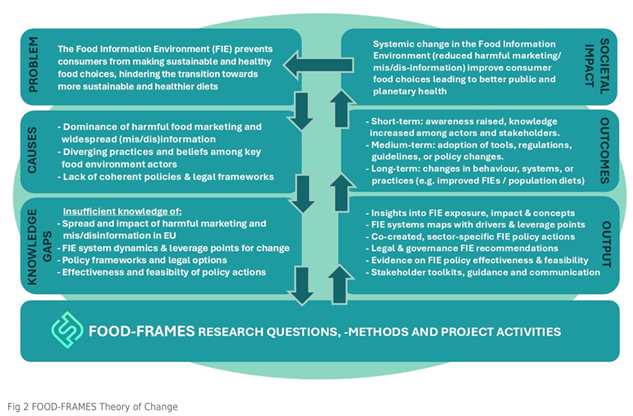
FOOD-FRAMES is guided by a Theory of Change (see figure below) that moves beyond sectoral or disciplinary silos to develop actionable, scalable solutions that address the root systemic drivers of unsupportive FIEs. By embedding principles of sustainability (incl. dietary health, economic accessibility, and social equity) and recognising the FIE as part of the broader food system, shaped by political, legal, social, technological and economic structures, our approach ensures to deliver relevant and impactful outcomes.
Implementation and plans to reach target groups
In the short term (start–month 12), policymakers, civil society, legal experts, WP partners and local actors will be engaged to raise visibility, initiate co-creation, and share goals and early concepts. In the medium term (months 12–30), media platforms, the food industry, health actors and policymakers will be engaged to share insights, build awareness, and expand reach. In the long term (months 30–48), policymakers, consumers, and scientific and legal communities will be engaged to disseminate outputs, promote uptake, and support reuse. Target groups will be identified through consortium networks, stakeholder mapping, purposive and snowball sampling, and online and offline outreach.
Partners of the project
-
Dr. Maartje Poelman
Associate Professor, Chair Group Consumption & Healthy Lifestyles, Department of Social Sciences, Wageningen University, the Netherlands
Mail: maartje.poelman@wur.nl
-
Prof. Janas Harrington, University College Cork, School of Public Health, Ireland
Prof. Dr. Laura König, University of Vienna, Faculty of Psychology, Austria
Prof. Dr. Peter von Philipsborn, University of Bayreuth, Chair of Public Health Nutrition, Germany
Prof. Dr. Carl Lachat, Ghent University, Department of Food Technology, Safety and Health, Belgium
Prof. Liv Elin Torheim Norwegian Institute of Public Health Department of Physical Health and Ageing, Norway
Prof. Dr. Lena Frischlich University of Southern Denmark Digital Democracy Centre, Denmark
Dr. Silvia Rolandi University of Pisa, Italy
Dr. Stefanie Vandevijvere Sciensano Health Information, Belgium
Prof. Dr. Eva Rehfuess LMU Munich Chair of Public Health and Health Services Research, Germany
-
The Netherlands – NWO
Ireland-DAFM
Germany – BMEL
Belgium – FWO
Italy – MUR
Austria – FWF
Denmark - DAFA/IPD
Norway – RCN