

Food Triggers
Societal tipping points for sustainable diets
Introduction
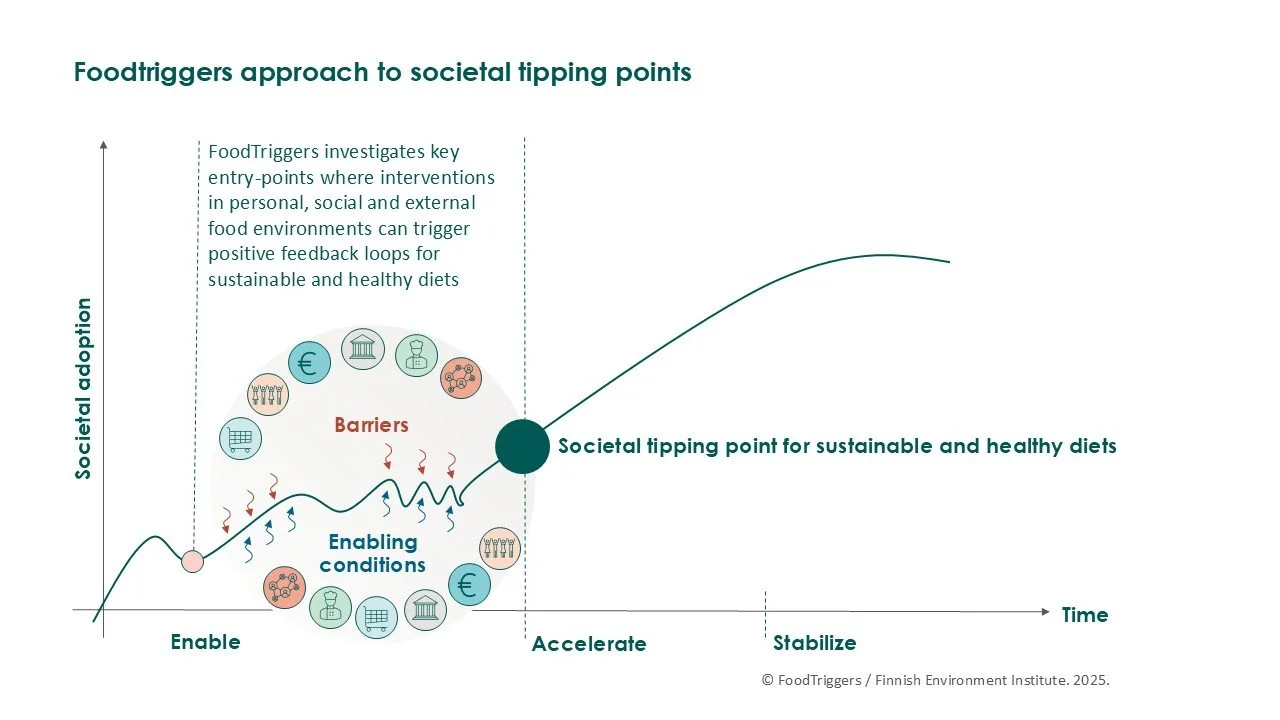
FoodTriggers investigates how societal tipping points can accelerate the transition towards sustainable diets that benefit both human and planetary health. These tipping points are critical moments at which small changes can trigger wider shifts in behaviours and systems, leading to lasting transformation.
Across Northern and Southern Europe, the project identifies key intervention points within personal, social, and external food environments that can generate positive feedback loops and accelerate the adoption of more sustainable dietary patterns and food systems.



societal tipping points, food environment, sustainable diets, Nordic diet, Mediterranean diet
2026-2029
Background
Food environments are key entry points to trigger societal tipping points for sustainable diets. Food environment is the interface that mediates people’s food acquisition and consumption within the food system. In Europe, food environments are changing rapidly. In this rapidly evolving landscape, there is a critical window of opportunity to redesign food environments in support of sustainable diets.
FoodTriggers starts from the assumption that multiple cascading actions are needed to trigger positive feedback loops for sustainable diets.
FoodTriggers identifies entry points for redesigning food environments across Northern and Southern European contexts. The comparison between the different contexts offers a unique opportunity to develop understanding of levers triggering societal tipping points.
What we do
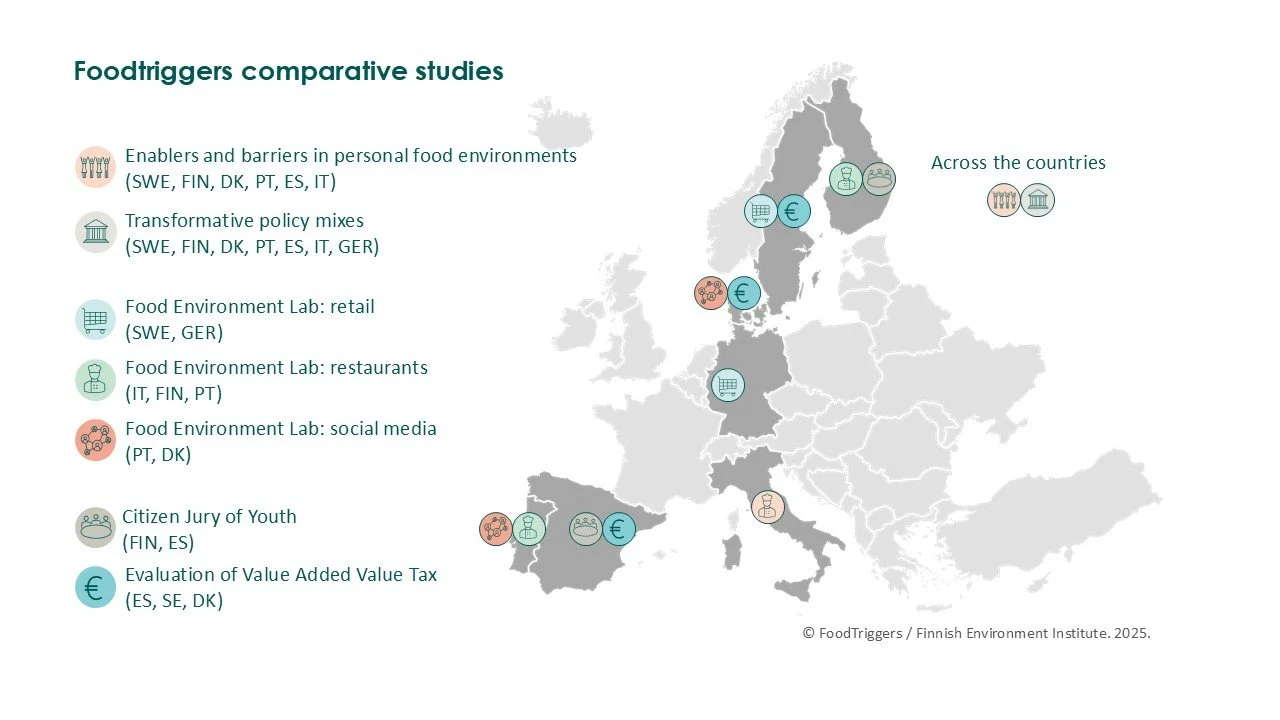
Comparing barriers and enabling factors for sustainable diets across different European contexts and population groups, and identifying areas where interventions are most likely to achieve broad support and impact.
Establishing Food Environment Labs in collaboration with partners from the retail, restaurant, and social media sectors to test innovative approaches for transforming physical and digital food environments.
Co-creating a sustainability assessment tool for retail food environments, alongside practical guidelines to support more responsible and sustainable food marketing on social media.
Evaluating the real-world impact of reduced VAT rates for healthy foods in Spain and testing similar price-based interventions in Nordic countries to identify effective economic incentives for healthier and more sustainable food choices.
Analysing and comparing policy mixes that support sustainable diets, conducting Citizen Juries to capture public perspectives, and developing a policy framework to support evidence-based decision-making at national and European levels.
Expected impact on food system transformation
The unique comparative setting of FoodTriggers allows to co-produce novel understanding of societal tipping points as applied to dietary shifts. The transdisciplinary approach, combining co-creation with retailer companies, restaurants, industry associations, social media influencers, public officials and decision-makers delivers results that are applicable to practice from regional to national and EU-levels.
The assessment tool for retail food environment, guidelines for social media marketing and transformative policy mix framework are designed to be applicable across European contexts.
Implementation and plans to reach target groups
FoodTriggers consortium works with associated partners from retail, restaurants, associations and public administration. The Food Environment Labs, FoodTriggers panels and Scientific and Stakeholder Advisory Board are established to ensure active interaction, scalable outcomes and societal impact.
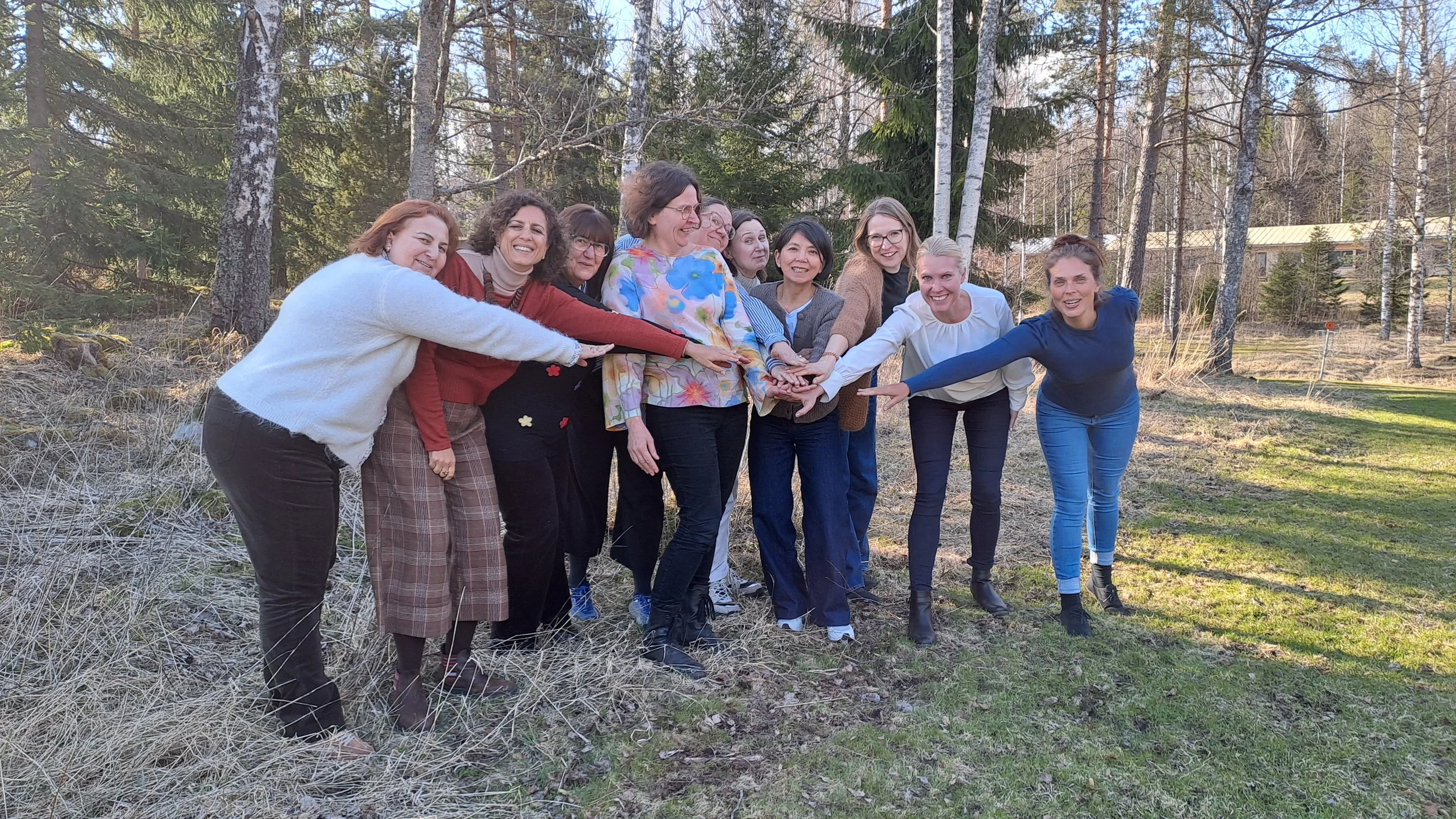
Partners of the project
-
Prof. Minna Kaljonen, Finnish Environment Institute, Finland
-
Researcher, Sarah Säll, Swedish University of Agricultural Sciences, Sweden
Prof. Jørgen Dejgård Jensen, University of Copenhagen, Denmark
Ass. Prof. Francesca Galli, Università di Pisa – Dipartimento di Scienze Agrarie, Alimentari e Agro – ambientali
Ass. Prof. Elisabete Cristina Bastos Pinto, Universidade Católica Portuguesa, Portugal
Researcher, Azucena Gracia, Centro de Investigación y Tecnología Agroalimentaria de Aragón (CITA)
Researcher, Hyewon Seo, Umweltbundesamt, Germany
Associated partners: Pro Vege ry (Finland), Slow Food Roma (Italy), Coop Östra (Sweden), The Directorate-General of Health (Direção-Geral da Saúde; DGS, Portugal)
-
The Ministry of Agriculture and Forestry, Finland
Vinnova, Sweden
Danish Agricultural and Fisheries Agency, Denmark
Ministerio de Ciencia, Innovación y Universidades, Spain
Ciência e a Tecnologia, I.P. (FCT), Portugal
Federal Ministry of Agriculture, Food and Regional Identity/ Federal Office for Agriculture and Food, Germany
-