
FULCRUM
Food System Labs: Policy Coherence and Empowerment to Transform Food Systems within a Just Circular Bioeconomy
Introduction
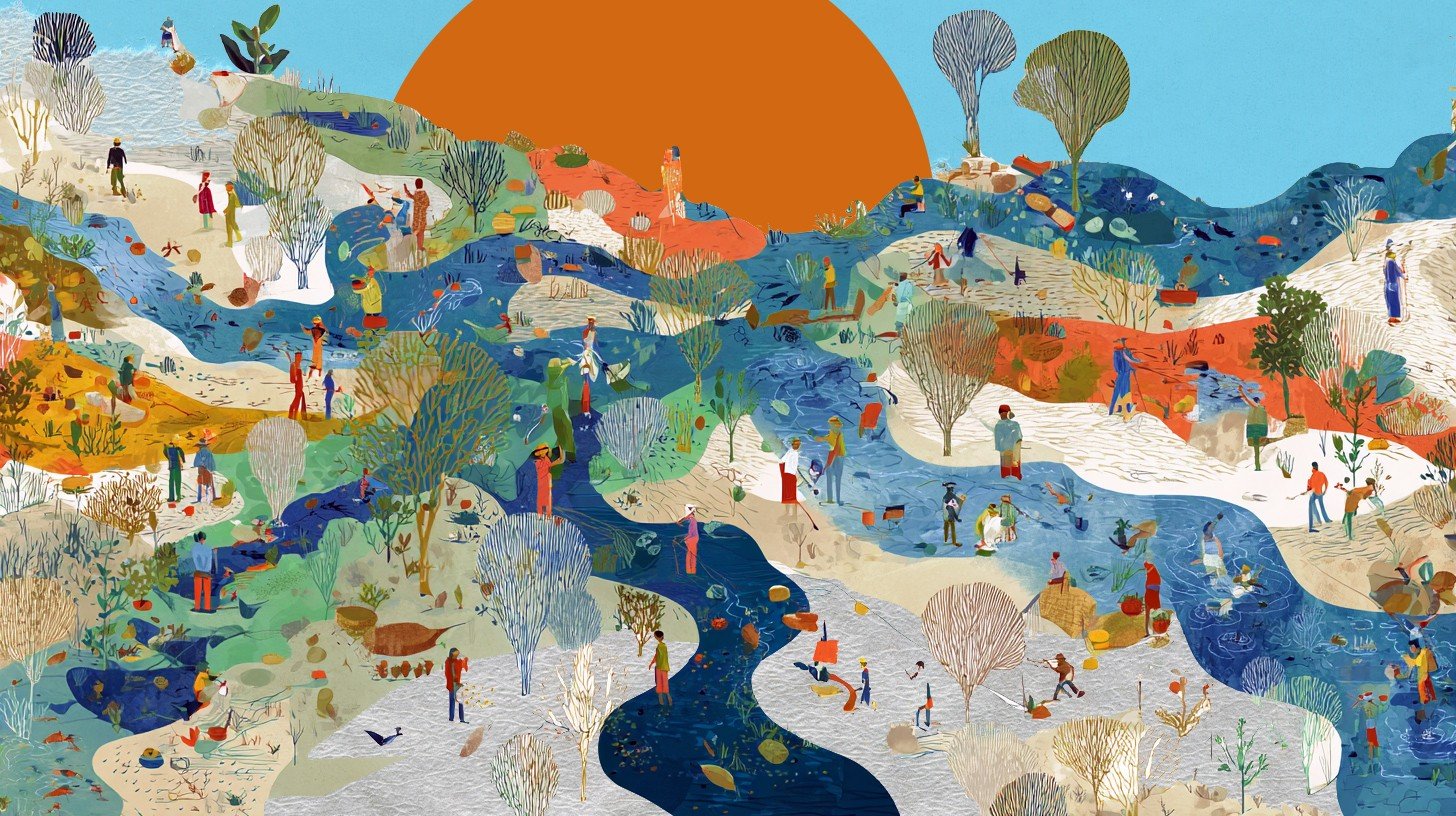
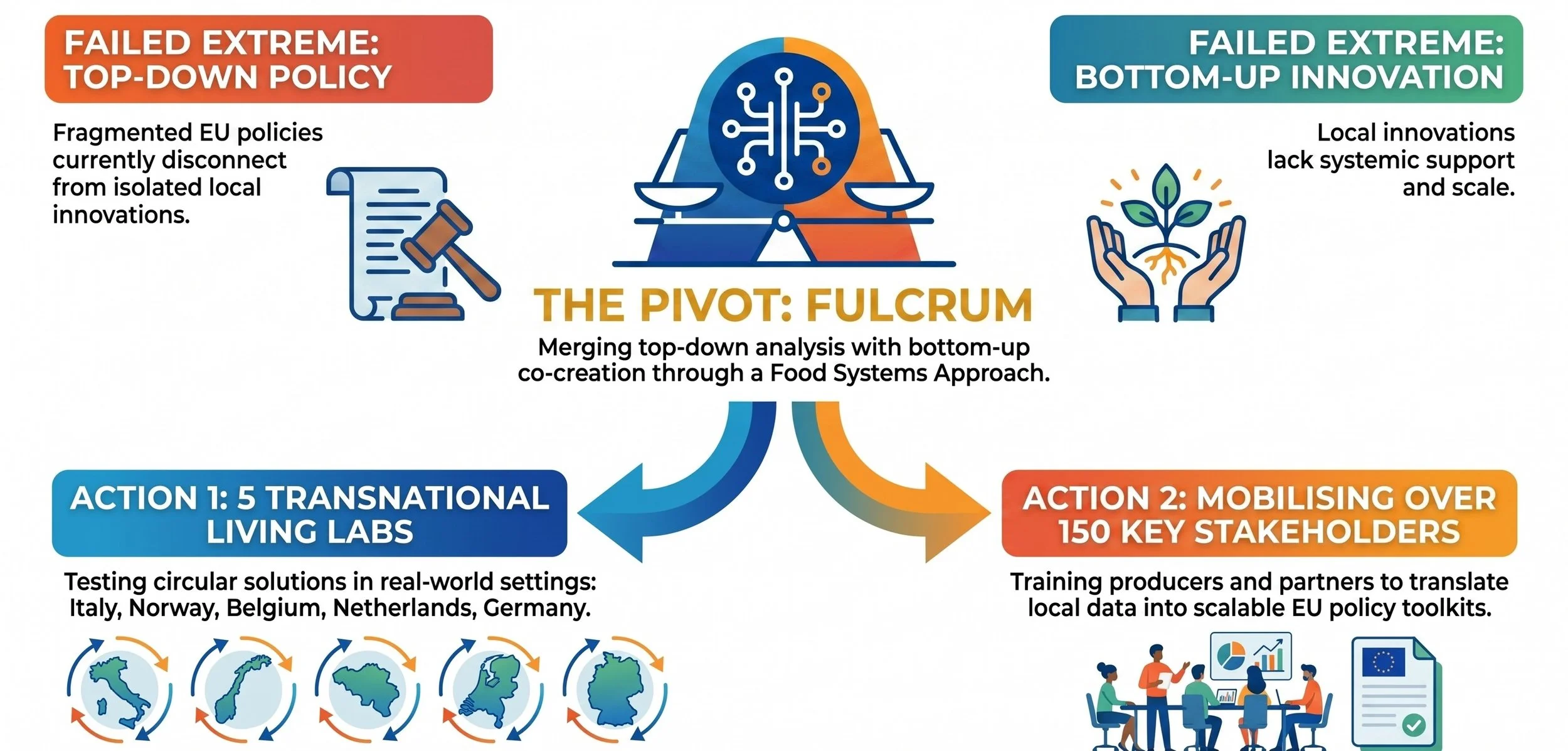
FULCRUM envisions a world where circular and just bioeconomy strategies contribute to sustainable food system transformation. While bioeconomy policies have been advanced by the EU and Member States, too often these policies reward capital intensive, high-tech solutions that exclude key actors, such as smallholder farmers, fishers, SMEs, citizens and consumer groups. By engaging these actors in co-designing bioeconomy strategies in five different regions across Europe, FULCRUM connects bottom-up innovation with actionable and scalable policy recommendations for living and vibrant land and seascapes.

Bioeconomy, circularity, food systems approach, land and seascapes, smallholders, equity
2026-2029
Background
The bioeconomy – an economy based on the replacement of fossil fuels with renewable biological resources - can be crucial to planetary health. However, this is not a given; just because resources are renewable does not mean that they deliver an economy that is sustainable. The dominant bioeconomy framework is still centred largely on the commodification of nature and knowledge in the service of limitless growth and economic competitiveness. FULCRUM seeks to deliver an alternative vision of the bioeconomy with a strong emphasis on de-intensification, decentralisation, and regeneration through a focus on approaches such as agroecology and the reduction of material footprints as well as by addressing key questions of governance, power, and agency.
What we do
Co-design of just and circular bioeconomy strategies in five regional Living Labs across marine and terrestrial settings in Norway, the Netherlands, Germany, Belgium and Italy.
Real-world testing of bioeconomy strategies in relation to the valorisation of waste streams from fish farming; the sustainable marketing of non-commercial fish species and side-streams; the closing of rural-urban nutrient loops; the transformation of surplus food into food and non-food bio-based products to prolong shelf-life; combining eco-based living, sustainable building materials, and local food production, and more.
Identification of structural barriers, policy lock-ins, levers for change through dynamic systems modelling (causal loop diagrams and stock-in-flow models).
Delivery of an EU policy innovation toolkit for scalable and actionable just, circular bioeconomy strategies.
Formation of a transnational learning network in the form of local Food and Bioeconomy Councils that are engaged in workshops, trainings, and the scaling up and out of policy toolkits.
Expected impact on food system transformation
FULCRUM acts as the pivot to tip food systems towards greater circularity, equity, and resilience. We adopt a food systems approach to examine ecological, socio-economic, and political inter-dependencies. These interdependencies will be explored through scoping, systems modelling, policy analysis, and the testing and co-design of innovative solutions, to allow us to develop policy toolkits that are popularised by our transnational learning network and communication activities.
Implementation and plans to reach target groups
FULCRUM brings together nine different partners across Europe with diverse and complementary expertise in the fields of systems thinking, food technology, strategic foresight, political science, and social movement theory. We will leverage this diverse expertise and related networks to engage key target groups, with a particular focus on more marginalised food system actors, including smallholder farmers, fishers, SMEs, women, and youth. We will also be setting up five regionally based, multi-actor Food and Bioeconomy Councils that will foster transnational learning and long term uptake and exploitation of FULCRUM’s outputs. In addition to scientific papers, FULCRUM will be using graphic illustrations, social media reels, blogposts, articles, longreads, and accessible research briefs to communicate project findings.
Partners of the project
-
Dr. Giovanna Ottaviani Aalmo, Norwegian Institute of Bioeconomy research (NIBIO), Norway
-
Dr. Pablo Vidueira Mera
Universidad Pontificia Comillas (Spain)
Prof. Dr. Peter Feindt
Humboldt-Universität zu Berlin (Germany)
Ms. Sylvia Kay
Transnational Institute (The Netherlands)
Prof. Concetta Maria Messina
University of Palermo (Italy)
Mr. Daniel Mattisson
RISE Research Institutes of Sweden (Sweden)
Dr. Bart VanDroogenbroeck
ILVO (Belgium)
Prof. Dr. Liesbet Vranken
University of Leuven (KU Leuven) (Belgium)
Mr. Janeelco Jansma
Stichting Wageningen Research (The Netherlands)
-
For NIBIO, Norway: The Research Council of Norway (RCN)
For Universidad Pontificia Comillas, Spain: Agencia Estatal de Investigación (AEI)
For Humboldt-Universität zu Berlin, Germany: Bundesministerium für Forschung, Technologie und
Raumfahrt (BMFTR), via Projektträger Jülich (PtJ)
For Transnational Institute (TNI), Netherlands: De Staat, vertegenwoordigd door de Minister van Landbouw, Visserij, Voedselzekerheid en Natuur (MIN-LVVN)
For Università degli Studi di Palermo (UNIPA) Italy: Ministero dell’Università e della Ricerca (MUR)
For RISE Research Institutes of Sweden, Sweden: Formas Forskningsrådet för miljö, areella näringar och samhällsbyggande
For EV ILVO, Belgium: Fonds voor Wetenschappelijk Onderzoek – Vlaanderen (FWO)
For KU Leuven, Belgium: Fonds voor Wetenschappelijk Onderzoek – Vlaanderen (FWO)
For Stichting Wageningen Research, research institute Wageningen Plant Research (WR), Netherlands:
De Staat, vertegenwoordigd door de Minister van Landbouw, Visserij, Voedselzekerheid en Natuur (MIN-LVVN)