
MicroMar
Sustainable processing of microbial and marine resources for novel food ingredients and products
Introduction
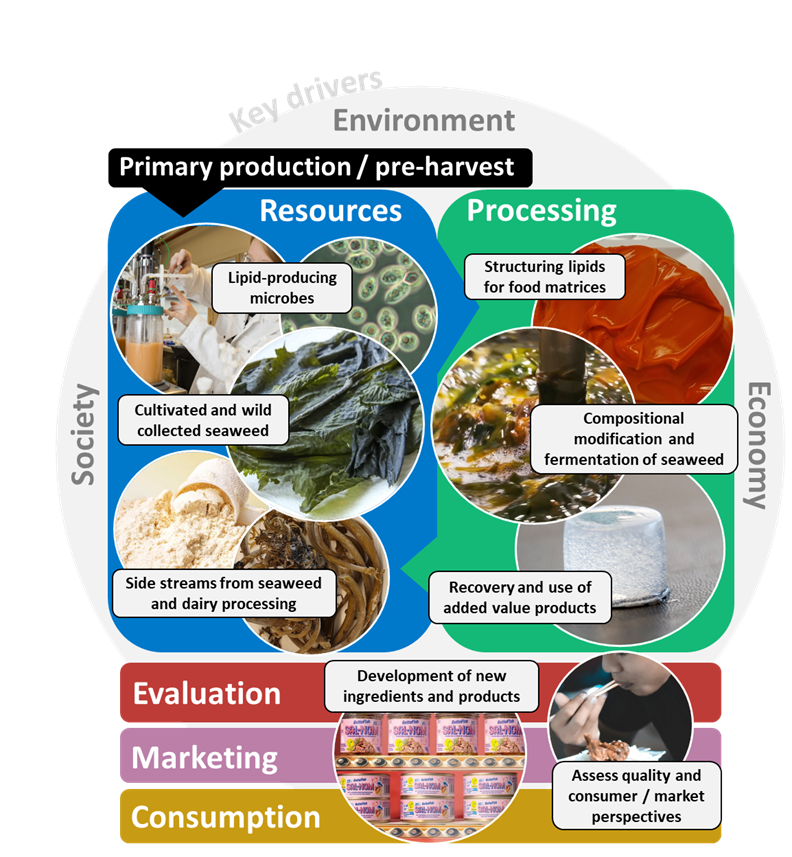
The aim of the MicroMar project is to develop effective production and processing of novel food ingredients and innovative food prototypes targeting the European market, based on seaweed and microbially produced oils. This can contribute to an increased food supply from underutilized resources using production and processing methods with a small environmental footprint. The project will employ sustainably wild collected and cultivated seaweed from the Atlantic Ocean, as well as agriculture and food processing side streams available across Europe, and develop products targeting consumers across all regions and demographics.
The project will employ innovative processing technology to enrich nutrients, improve food safety and sensory properties of sustainably harvested and cultivated seaweed, and extract component with functional properties for food matrices. Secondly, the project will innovate in the production of oils from marine protists and yeast using sustainable feedstocks from land-based and marine resources, and process and structure these oils into novel ingredients and food products.

Seaweed, macroalgae, microbial food, lipids, new foods
2026-2029
TRL: 2-6
Background
It is expected that food production will need to increase by more than 60% by 2050, while ensuring that everyone has access to sufficient healthy food. This is not possible with today’s food systems, which are already facing large sustainability issues. Moreover, more than 820 million people are currently starving, and a much higher number face malnutrition, obesity, and other diet-related issues. European strategies on food production and bioeconomy highlight increased use of marine renewable resources as well as microbially produced ingredients as key contributors to a more resilient and sustainable food system, and to the growing global bioeconomy. However, there is a still a need to demonstrate use of these novel ingredients in everyday foods for European consumers, as well as how they can be produced at large scale in an environmentally and economically feasible manner.
What we do
Processing of seaweed to improve sensory properties and food safety, and extraction of hydrocolloids for use in ingredient formulation;
Use of side streams from seaweed processing and agricultural food production as feedstocks for microbial oils;
Structuring of microbial oils into gels, foams, and emulsions for use as food ingredients;
Development and evaluation of new products (seaweed- and fat-based);
Dissemination and communication of project results to key stakeholder groups.
Expected impact on food system transformation
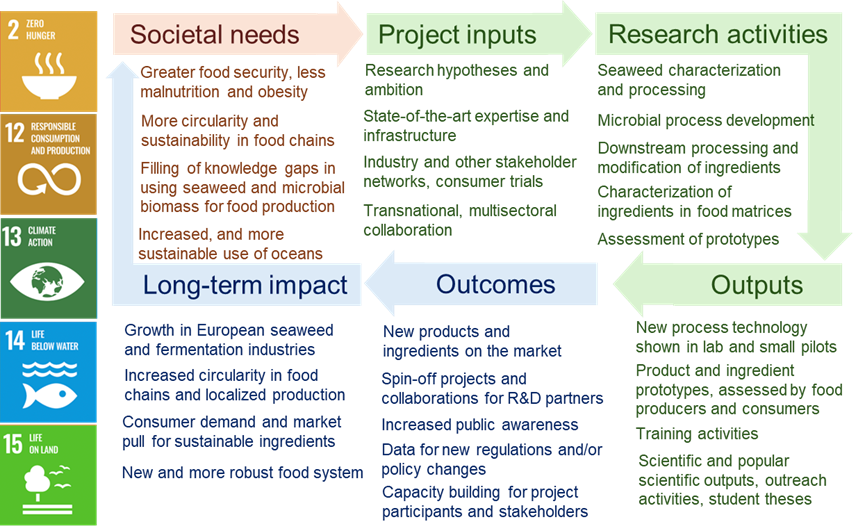
MicroMar aims to drive the transition to Sustainable Food Systems by creating new foods from renewable and underutilized bioresources in Europe. The project’s goal is to ensure that these products are produced in an environmentally friendly manner, minimizing negative impacts such as greenhouse gas emissions, loss of biodiversity, use of water and land including deforestation and pollution. MicroMar is expected to have a substantial impact on the environment and social development and is well aligned with UN’s Sustainable Development Goals.
The key goal is 2. Zero hunger (Targets 2.1-2.4) as the project will contribute to feeding a growing world population, increasing food security, improving circularity and productivity, and reducing malnutrition. The project’s envisioned pathway to impact is illustrated below.
Implementation and plans to reach target groups
The project has developed a dissemination, exploitation, and communication (DEC) plan including key target groups (industry, scientific community, consumers, and authorities/policy makers), and means for communicating and maximizing impact from interaction with each of these groups. The main objectives of this work will be to ensure open and high-impact dissemination of data, transfer of knowledge and methodology to industry, inclusion of the public in outreach and co-creation activities, and input to new policies related to sustainable food production.
Partners of the project
-
Oystein Arlov, SINTEF AS
-
Wageningen Food & Biobased Research,
Fraunhofer IVV,
Politecnico di Torino, Wunderfish GmbH,
Lofoten Seaweed Company,
European Seaweed Association (associated partner)
-
NFR (NOR),
BMEL (DE), MUR (IT), NWO (NL)
-
Item description