
BlueGreenFood
Innovating Sustainable and Healthy Food Alternatives through Seaweed and Plant-Based Proteins
Introduction
What:
BlueGreenFood aims to develop sustainable seaweed-based foods and ingredients for the European market.
Why:
Europe needs more sustainable and locally produced food. Seaweed, microalgae, and plant-based proteins can provide healthy food while reducing pressure on conventional agriculture and fisheries. However, the European seaweed industry is in its early stage, and faces several challenges including developing low-energy preservation methods, ensuring stable supply of raw material, and creating appealing food products that achieve high consumer acceptance. BlueGreenFood aims to solve these challenges by developing sustainable preservation methods, and creating nutritious and attractive food products, thereby supporting the growth of a strong and sustainable European seaweed industry.
Where:
The project focuses on marine and food systems across Europe, covering the Nordic region (Norway, Iceland, Denmark, Finland), the Baltic region (Lithuania), and Southern Europe (Portugal), with the goal of supporting sustainable food production and markets throughout Europe.



seaweeds, sustainable food systems, preservation, processing, consumer preferences
1-02-2026 – 01-31-2029
Background
Europe faces increasing pressure on agriculture, fisheries, and land resources because of climate change and increasing food demand. Seaweeds recycle nutrients, capture CO2, and support ocean health, while representing resource-efficient and nutritious biomass. The European seaweed farming sector has made notable advancements in recent years across several species, yet key challenges remain before it can contribute significantly to the green transition of the food system. Ensuring year-round stability of seaweed biomass remains one critical barrier. Traditional preservation methods like freezing and drying consume large amounts of energy and are costly. Alternative preservation methods such as silage and fermentation are promising but difficult because of seaweed’s high salt content and low ambient temperatures. Consumer acceptance of foods based on European seaweeds is still limited due to lack of familiarity and cultural tradition. Nutritional value, food quality and appeal of seaweed products can be improved by introducing other alternative proteins like seeds and microalgae.
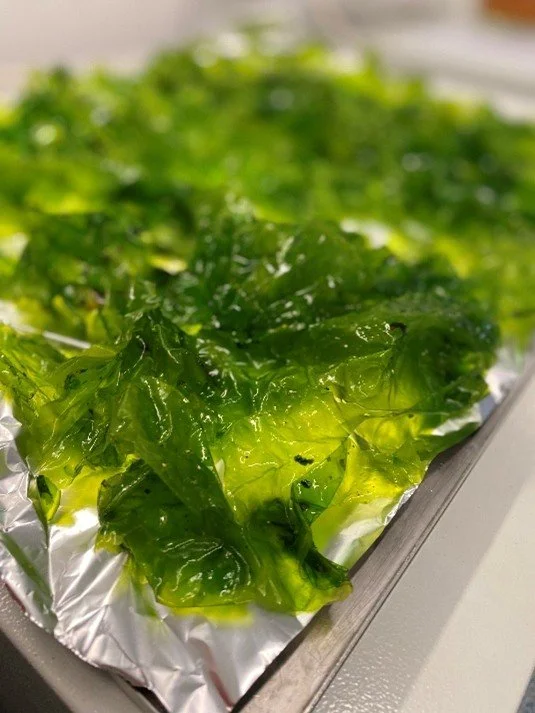
Picture 1: fresh Ulva
What we do
The main aim of BlueGreenFood is to unlock the potential of seaweed, protein rich seeds and microalgae for innovative, healthy, and sustainable food with high acceptance in European markets, which will be achieved by following activities:
Development of new and optimisation of existing seaweeds preservation methods for ensuring stable biomass supply.
By employ living cell factories to produce microbial cultures suitable for seaweed preservation and producing healthy food products.
To understand how novel preservation and processing methods influence chemical and sensory quality.
Process seaweed, protein rich microalgae and plant-based proteins (from different seeds) into innovative, profitable, safe, healthy, and nutritional products.
Understand market demands to reach industry and European food markets with innovative green-blue food.
Enable a zero-waste concept by full utilization of biomass.
Increase the social acceptance of the developed food products.
Safeguard an environmentally friendly and sustainable value chain.
Expected impact on food system transformation
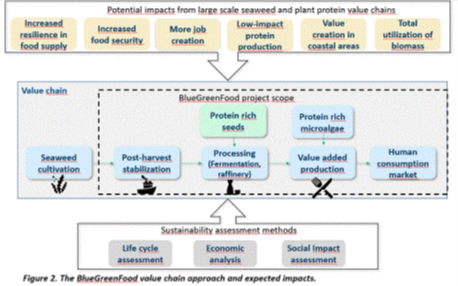
BlueGreenFood will support the transition to more sustainable and resilient food systems in Europe. It promotes seaweed, microalgae, and plant-based proteins as environmentally friendly alternatives to conventional food sources. Energy-efficient preservation and processing technologies will help reduce waste and ensure stable year-round biomass supply. The project also improves circularity by utilizing side streams from marine and agricultural biomass. Nutritious and appealing food products will be developed to meet growing consumer demand for sustainable diets. A value-chain approach connects cultivation, processing, product development, and market uptake across Europe. Consumer studies and industry collaboration will help increase acceptance of seaweed-based foods in different European markets. The project integrates a theory of change by linking innovation, sustainability assessments, and consumer engagement. Environmental, social, and economic impacts will be evaluated continuously to guide sustainable decision-making. Overall, the project contributes to the EU green transition by supporting low-impact and resource-efficient food systems.
Implementation and plans to reach target groups
BlueGreenFood will support the transition to more sustainable and resilient food systems in Europe. It promotes seaweed, microalgae, and plant-based proteins as environmentally friendly alternatives to conventional food sources. Energy-efficient preservation and processing technologies will help reduce waste and ensure stable year-round biomass supply. The project also improves circularity by utilizing side streams from marine and agricultural biomass. Nutritious and appealing food products will be developed to meet growing consumer demand for sustainable diets. A value-chain approach connects cultivation, processing, product development, and market uptake across Europe. Consumer studies and industry collaboration will help increase acceptance of seaweed-based foods in different European markets. The project integrates a theory of change by linking innovation, sustainability assessments, and consumer engagement. Environmental, social, and economic impacts will be evaluated continuously to guide sustainable decision-making. Overall, the project contributes to the EU green transition by supporting low-impact and resource-efficient food systems.
Partners of the project
-
SINTEF Ocean (Norway).
-
Kaunas University of Technology, Lithuania
VTT Technical Research Centre of Finland, Finland
Universidade de Aveiro, Portugal
University of Iceland, Iceland
Technical University of Denmark, Denmark
Norwegian Seaweed Cluster, Norway
SPILA, UAB, Lithuania
SALDOGA, UAB Lithuania
-
The Research Council of Norway
Lietuvos mokslo taryba (LMT)
Maa- ja metsätalousministeriö (MMM)
Fundação para a Ciência e a Tecnologia (FCT)
Rannsóknamiðstöð Íslands (RANNIS)
Innovationsfonden (INNOFOND)