

Miprodesign
Accelerating plant-based protein emulsion design with microfluidics and intelligent software tools for sustainable foods
Introduction
Most food emulsions—such as drinks, sauces, and yogurts—depend on animal-based proteins (e.g., from eggs or milk) to meet requirements for stability, digestibility, and taste. This reliance is unsustainable due to the high environmental footprint of animal proteins. A rapid protein transition is needed, yet little is known about how plant proteins function in emulsions, and current testing methods are slow, costly, and resource-intensive. MIPRODESIGN addresses the limited knowledge about plant proteins by introducing an automated microfluidic technology combined with intelligent software tools. This methodology is anticipated to accelerate the development of sustainable, plant-based emulsions, as shown in Fig. 1. This work will be performed by partners in Norway, the Netherlands, Spain, and Germany.



Plant proteins, microfluidics, intelligent software, emulsions
2026-2029
TRL: 2-4
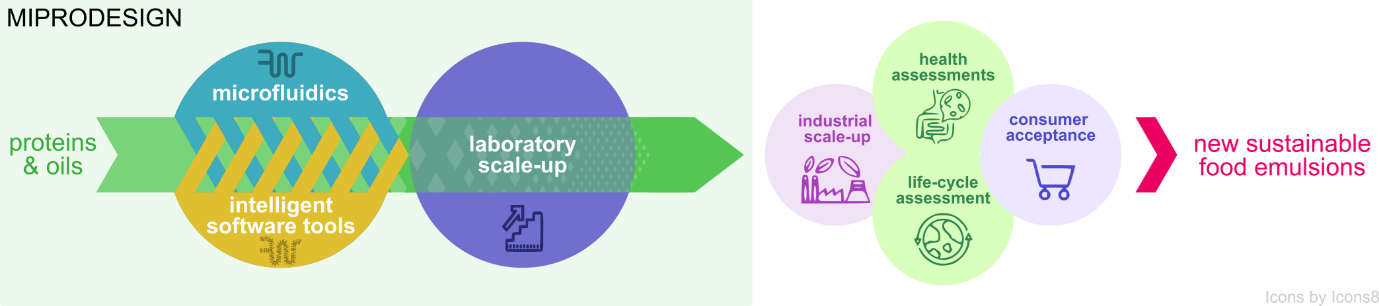
Figure 1. Integration of microfluidics and intelligent software tools for the rapid design of new sustainable food emulsions with plant-based proteins. The identified optimized conditions will then be translated to a lab-scale emulsification process. In the future, these laboratory prototypes will be scaled up in an industrial setting and subjected to assessments for health and safety, life-cycle, and consumer acceptance.
Background
One solution to improve the sustainability of emulsion ingredients is to replace animal-based proteins with plant-based ones. This task is non-trivial, because plant proteins typically result in worse emulsion stability. Many protein sources and isolation methods exist, but there is scant knowledge of their functionality in food emulsions, and current techniques are time- and material-intensive. There is thus a pressing need to develop new methods to rapidly screen potential protein sources. Such a screening process must satisfy a multidimensional web of requirements, and it must effectively replace current food design methodologies that use high-cost trial-and-error approaches. MIPRODESIGN aims to fill this gap by developing a low-volume, rapid methodology based on microfluidics.
What we do
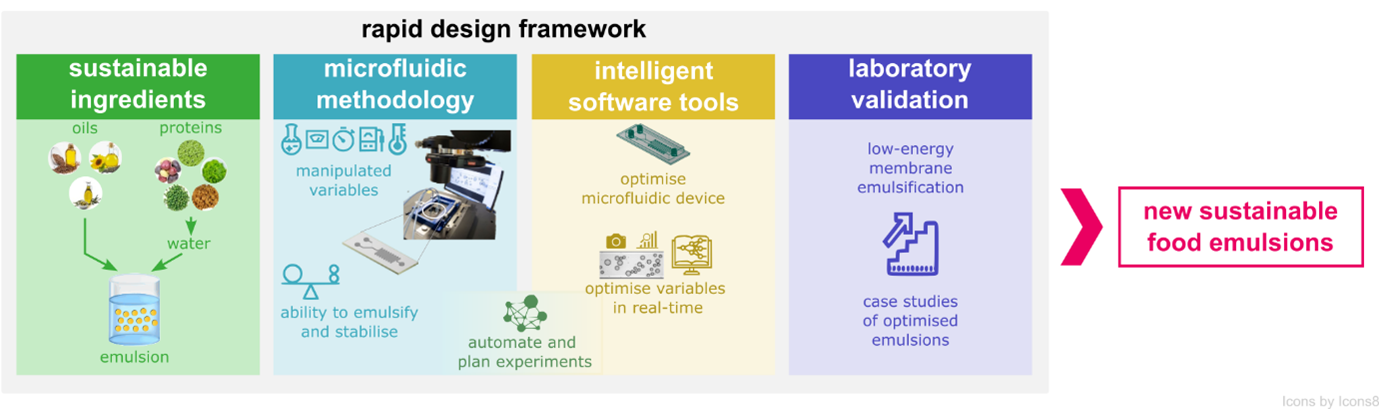
Selecting proteins and oils will be and ranked based on consumer preferences, nutritional value, environmental impact, and stakeholder input.
Machine learning and physics-based models will guide the optimal design of microfluidic systems and enable real-time analysis of oil-in-water droplets.
Microfluidic emulsions will then be tested for physicochemical stability and digestibility under key food-relevant conditions (protein concentration, pH, salinity, and temperature) to identify optimal formulations.
To validate scalability, the best microfluidic formulations will be transferred to a membrane emulsification process, which uses far less energy than conventional methods in industry.
Stakeholders will be engaged throughout the project to maximize input and uptake of results.
Expected impact on food system transformation
MIPRODESIGN will strengthen the link between plant protein producers and end users, enabling faster development of sustainable plant-based foods.
The project contributes to environmental, economic, and social goals: reducing environmental impact, improving production efficiency, and supporting healthier diets.
Once validated, the methodology can extend to other food systems, including nutrient-fortified functional foods. Microfluidics combined with intelligent software could become a powerful catalyst for screening, optimizing, and ensuring the safety of future food ingredients.
Implementation and plans to reach target groups
A Stakeholder Board is established to engage relevant target groups, including ingredient suppliers, drink manufacturers, and microfluidic technology companies. Co-design and co-creation workshops will take place to communicate project activities and incorporate target groups’ insights to inform project activities and to facilitate uptake. Open access publications and software will be made available for use by industry and academia. Project participants will also contribute to conferences, trade fairs, and media appearances to reach the public and consumers.
Partners of the project
-
Nadia Shardt, PHASE Laboratory, Norwegian University of Science and Technology (NTNU), Norway
Mail: nadia.shardt@ntnu.no
-
Karin Schroen, Food Process Engineering Laboratory, Wageningen University and Research, Netherlands
Maria Carmen Guell Saperas, Food Innovation & Engineering Research Group, Universitat Rovira i Virgili, Spain
Robert Wille, Chair for Design Automation, Technical University of Munich, Germany
-
Research Council of Norway (NFR), Norway
Dutch Research Council (NWO), Netherlands
State Research Agency (AEI), Spain
Federal Ministry of Research, Technology and Space (BMFTR), Germany