
Truefoods
Transforming European Food Systems: Sustainability, Equity, Governance and Resilience as core elements
Introduction
TrueFoodS supports the transition towards more sustainable, inclusive, and resilient European food systems by addressing key challenges in post-harvest processes across Europe. The project brings together researchers, policymakers, businesses, and local communities to develop practical solutions that integrate environmental, social, and governance perspectives.
Across Europe, food systems are currently affected by issues such as food waste, fragmented policies, environmental pressures, and social inequalities, all of which undermine their long-term sustainability and resilience. TrueFoodS responds to these challenges by fostering collaboration and innovation to strengthen post-harvest food systems.
The project is implemented in a diverse set of regional and local contexts across Belgium, Portugal, Italy, Romania, Bulgaria, Sweden, Germany, and Spain, reflecting a wide range of environmental, socio-economic, and governance conditions.


Sustainable Food Systems, Circular Economy, Post-Harvest Resilience, Equity and Inclusion, Policy Harmonisation
2026-2029
TRL: 3
Background
TrueFoodS supports the transition towards more sustainable, inclusive, and resilient European food systems by addressing key challenges in post-harvest processes across Europe. The project brings together researchers, policymakers, businesses, and local communities to develop practical solutions that integrate environmental, social, and governance perspectives.
Across Europe, food systems are currently affected by issues such as food waste, fragmented policies, environmental pressures, and social inequalities, all of which undermine their long-term sustainability and resilience. TrueFoodS responds to these challenges by fostering collaboration and innovation to strengthen post-harvest food systems.
The project is implemented in a diverse set of regional and local contexts across Belgium, Portugal, Italy, Romania, Bulgaria, Sweden, Germany, and Spain, reflecting a wide range of environmental, socio-economic, and governance conditions.
What we do
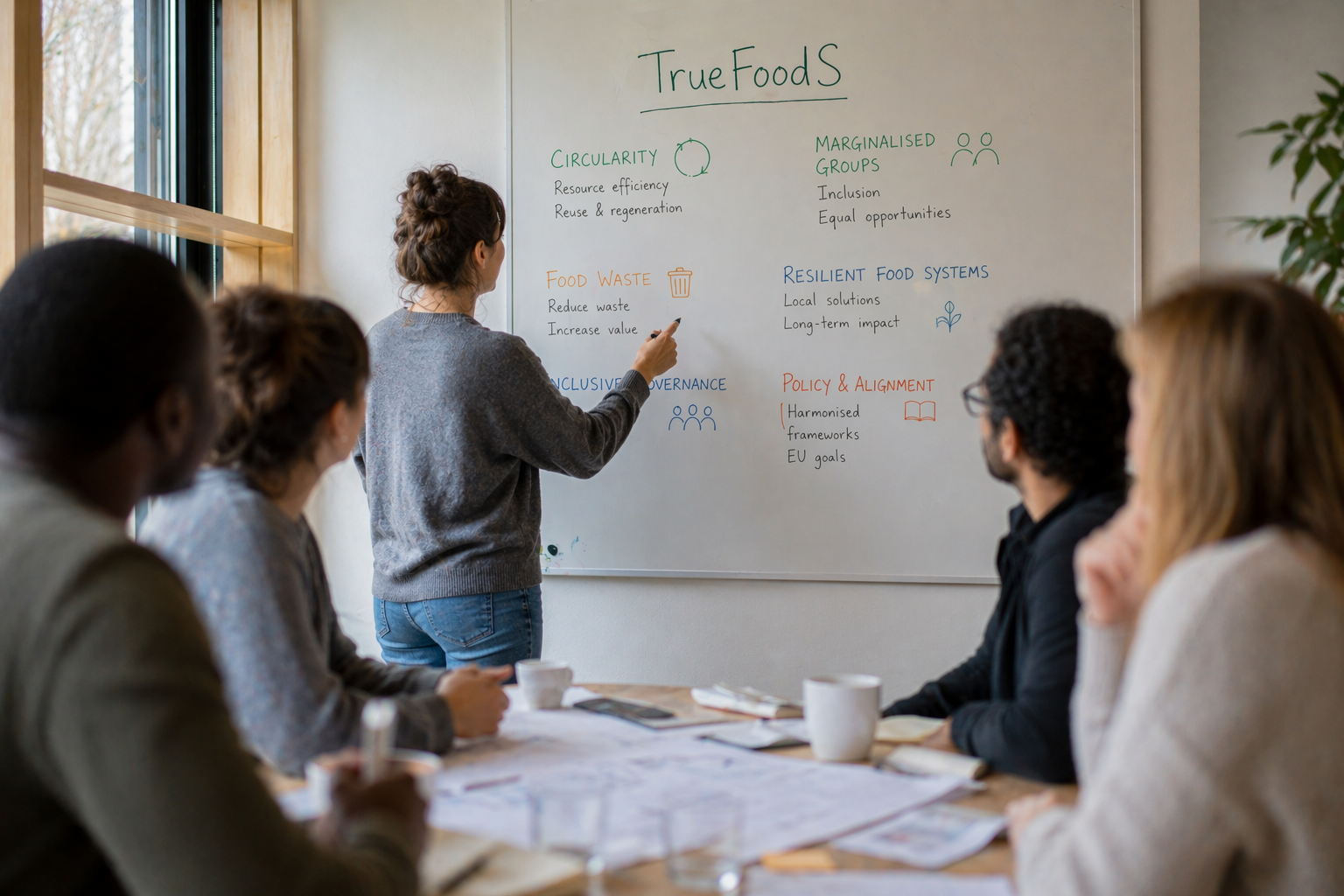
Mapping legal and policy gaps: We compare how eight EU countries regulate post-harvest food systems, identify what is missing, and propose practical legal and policy improvements.
Embedding circular economy principles: Through lifecycle analysis and co-creation with local actors, we design strategies that reduce food waste, recover resources, and cut greenhouse gas emissions in post-harvest stages.
Supporting SMEs and marginalised communities: We deliver training programmes, co-creation workshops, and a transnational mentorship programme specifically designed for small businesses, women-led enterprises, youth, and other underrepresented groups.
Building adaptive governance: We assess vulnerabilities in post-harvest systems and co-develop governance frameworks that help territories anticipate, absorb, and recover from economic, environmental, and social shocks.
Developing inclusive business models: Together with local communities and policymakers, we co-create and test business models that integrate sustainability and social equity, with a special focus on women-led and community-based organisations.
Engaging stakeholders across Europe: Through workshops, seminars, podcasts, and an open-access digital platform, we connect researchers, policymakers, civil society, and citizens around shared solutions for sustainable food systems.
Producing open-access tools and policy briefs: All project outputs: including policy toolkits, training manuals, governance roadmaps, and scientific publications, are freely available and designed for replication across EU regions.
Expected impact on food system transformation
TrueFoodS contributes to the transition towards sustainable, inclusive and resilient food systems by addressing interconnected legal, environmental, economic and governance barriers. It is based on the idea that lasting food systems transformation requires policy coherence, circular resource management, inclusive innovation and adaptive governance to be addressed together. It analyses CAP Strategic Plans and develops recommendations for future policy frameworks beyond 2027, while assessing food loss, food waste and resource inefficiencies through lifecycle analysis to design circular economy strategies. These insights are translated into practice through training, mentoring and inclusive business models for SMEs and local communities. By connecting policy, circularity, innovation and resilience, TrueFoodS aims to improve resource efficiency, strengthen social inclusion and enhance the capacity of European food systems to respond to future challenges.
Implementation and plans to reach target groups
TrueFoodS will engage researchers, policymakers, SMEs, farmers, civil society organisations, local communities and public authorities through a multi-actor approach. Stakeholders will participate in workshops, co-creation sessions, mentoring activities, capacity-building programmes and policy dialogues throughout the project. Communication and outreach will be supported through a project website, social media channels, newsletters, policy briefs, scientific publications and participation in national and international events. It benefits from strong networks across academia, government, industry and civil society. In addition, Associated Partners ACR+ and Food & Bio Cluster Denmark will support dissemination and stakeholder engagement activities to reach broader and more diverse audiences, while Rurinnova will facilitate engagement with farmers and local producers. These partnerships will strengthen the uptake, visibility and long-term impact of project results.
Partners of the project
-
Prof. Dr. Kim Van der Borght, Vrije Universiteit Brussel (VUB), Belgium, Mail: kim.van.der.borght@vub.be.
-
Vrije Universiteit Brussel (Belgium)
Hållbar Utveckling Skåne (SE)
Asociatia IRCES (Inst. for Climate, Economic & Social Resilience) (RO)
Alba Iulia Municipality (RO), Scuola Superiore Sant’Anna (IT), Ecologic Institute (DE),
IPNA-CSIC (Inst. of Natural Products & Agrobiology) (ES)
Universidade do Porto (PT)
University of Food Technologies – Plovdiv (BG)
Region Skåne (SE)
Associated Partners:
Finca Marañuela (ES)
ACR+ (Association of Cities and Regions for sustainable Resource management) (BE)
Food & Bio Cluster Denmark (DK)
Affiliated Partners:
Agriventures
-
Research Foundation Flanders (FWO, Belgium)
Executive Agency for Higher Education, Research
Development and Innovation Funding (UEFISCDI, Romania)
Ministry of University and Research (MUR, Italy)
Federal Ministry for Research, Technology and Space (BMFTR, Germany)
Sweden's Innovation Agency (Vinnova, Sweden)
Agencia Estatal de Investigación (AEI, Spain)
Fundação para a Ciência e a Tecnologia (FCT, Portugal)
National Science Fund (Bulgaria).
-